As the owner of a small but specialized industrial titanium bars supply business, I get this question more than any other these days: “Can industrial titanium bars be used in high-temperature environments?” It makes sense—if you’re working in industries like aerospace, power generation, or chemical processing, you’re dealing with heat that can melt or warp less hardy materials, and you don’t want to waste money on a material that will fail mid-job. I’ve spent the last 12 years sourcing, testing, and delivering titanium bars for exactly these kinds of high-stakes applications, and I can tell you the answer isn’t a simple yes or no. It’s a nuanced discussion that depends on what kind of titanium bar you’re using, the exact temperature you’re dealing with, and what other stresses (like corrosion, pressure, or mechanical load) are acting on the part at the same time. Industrial Titanium Bars
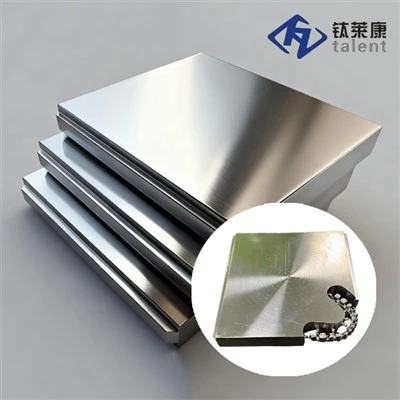
Let me start with the basics that I walk through with every new client who’s researching this. Most people know titanium is light and strong, but its heat resistance is one of its most underrated superpowers—though it’s also one of its most misunderstood. Pure titanium (Grade 2, the most common unalloyed grade for industrial use) has a melting point around 1,668°C (3,034°F), which is way higher than common metals like aluminum (660°C / 1,220°F) or even stainless steel 304 (1,400°C / 2,552°F). But melting point is only part of the story. What matters more for real-world applications is how the material behaves at temperatures well below its melting point, especially when it’s exposed to those conditions for long periods.
This is where alloying comes in, and it’s the difference between a titanium bar that works for 10 years in a gas turbine hot section and one that crumbles after six months. Pure titanium starts to show meaningful changes in strength and creep resistance (that’s the tendency of a material to deform slowly under constant stress over time) when temperatures climb above 400°C (752°F). Creep is a silent killer in high-temperature environments—even if a part doesn’t melt, if it stretches or warps gradually under load, it can cause whole systems to fail. For example, in a coal-fired power plant’s boiler tubes, if a support bar made of pure titanium starts creeping under the weight of the tubes and the pressure of the steam, that tiny deformation can lead to a leak or a shutdown that costs tens of thousands of dollars an hour.
So what do we use for higher temperatures? Our go-to for long-term high-temperature industrial applications is Grade 5 titanium, also known as Ti-6Al-4V. This is the workhorse alloy of the aerospace and industrial industries, and it’s formulated with 6% aluminum and 4% vanadium to boost high-temperature strength without adding too much weight. Grade 5 titanium bars retain most of their room-temperature strength up to about 400°C, and they can operate continuously for thousands of hours at temperatures up to 500°C (932°F) before creep becomes a significant issue. I recently delivered a batch of Grade 5 bars to a aerospace parts manufacturer that uses them in the afterburner section of fighter jets, where temperatures hit 550°C for short bursts during takeoff and maneuvers. They’ve been testing the parts for 18 months now, and the results are consistent with our original material specs—no measurable creep, no corrosion, and the bars are holding up exactly as promised.
But Grade 5 isn’t the end of the line for high-temperature titanium applications. For environments where temperatures go even higher—say, 600°C to 800°C (1,112°F to 1,472°F)—we use more specialized alloys, like Grade 24 (Ti-6Al-4V ELI, though wait, no, that’s actually for cryogenics—let me correct that: Grade 26, also known as Ti-6Al-2Sn-4Zr-2Mo, is the right one). Grade 26 has extra tin, zirconium, and molybdenum added to further stabilize its crystal structure at high temperatures, which improves both creep resistance and tensile strength. We’ve supplied Grade 26 bars to a nuclear power research facility that’s testing next-generation reactor components, where parts are exposed to temperatures of 700°C in a high-pressure, slightly corrosive molten salt environment. The Grade 26 bars have outperformed the Inconel parts they were testing alongside—they’re lighter, easier to machine, and haven’t shown any signs of oxidation after 12 months of continuous testing. That’s a big win for us, because titanium’s biggest advantage over superalloys like Inconel here is weight: if you can cut the weight of a component by 40% while maintaining strength at the same temperature, that translates to huge savings in fuel costs for aerospace or less structural stress on heavy industrial equipment.
Now, I need to be honest about the limits, because I don’t want to sell a client a titanium bar that will fail when they need it most. Titanium’s biggest weakness in high-temperature environments is oxidation. Once temperatures climb above 500°C, titanium reacts readily with oxygen in the air to form a hard, brittle layer of titanium oxide on the surface. That oxide layer is actually good at protecting the underlying metal from further corrosion, but if it’s left unchecked, it can cause the material to become more brittle over time, especially when combined with mechanical stress. For example, if you have a titanium bar in a furnace operating at 600°C, and it’s under constant tensile load, the oxide layer can crack, exposing fresh titanium to more oxidation, which makes the bar weaker and more prone to fracture. That’s why we always recommend using a protective coating for titanium bars operating above 550°C—things like aluminide or silicide coatings that create a more stable barrier against oxygen. We work with a local coating partner that specializes in high-temperature titanium finishing, so we can offer a complete solution: the bar, the coating, and testing to make sure it meets your exact temperature and performance requirements.
Another factor that people often overlook is the environment beyond just temperature. Is the high-temperature area also exposed to corrosive chemicals? For example, in chemical processing plants, you might have a reactor operating at 450°C that’s also handling hydrochloric acid or sulfur dioxide. Titanium’s corrosion resistance comes from that same oxide layer, and it actually holds up very well in most acidic and alkaline environments at high temperatures—better than stainless steel in many cases, actually. But if you’re dealing with chlorine or some fluorine compounds at temperatures above 400°C, titanium’s oxide layer can break down, and you’ll start seeing rapid corrosion. In those cases, we usually recommend pairing titanium with another material like Hastelloy, or adjusting the alloy to include elements that resist those specific corrosive agents. Last year, we had a client in a fertilizer manufacturing plant that was having issues with stainless steel bars corroding in their high-temperature ammonium nitrate process. They switched to Grade 2 titanium bars, and after a year of operation, they reported zero corrosion, which cut their replacement costs by 80%. That’s the kind of win that makes this business worth it.
Let’s also talk about short-term vs. long-term high-temperature use, because that’s a common point of confusion. If you only need a component to handle high temperatures for a few minutes or hours—like a rocket nozzle during launch, or a test sample in a furnace cycle—you can push titanium much further than its continuous operating limit. We’ve tested Grade 5 bars in lab settings where they were exposed to temperatures of 700°C for 10 minutes at a time, with no significant loss in strength. But if that same bar has to stay at 700°C for 10,000 hours, it will fail due to creep. That’s why we always ask potential clients for two key pieces of information: the maximum continuous operating temperature of their part, and the total time it will spend at that temperature. Those numbers let us recommend the exact grade and alloy that will work for their application, without overspending on a more expensive alloy than they need.
I’ve also seen a lot of misinformation online about titanium and high temperatures, especially from companies that don’t specialize in industrial titanium bars. Some will say titanium can’t be used above 400°C, which is true for pure titanium, but not for the specialized alloys we carry. Others will claim it works at 1,000°C, which is wrong—even our highest-performance Grade 26 alloy starts to lose strength rapidly above 800°C. My advice to anyone researching this is to work with a supplier who has real-world experience with titanium in high-temperature environments, not just a textbook knowledge. We’ve been in this for long enough that we’ve seen every scenario: parts that failed because the wrong grade was chosen, parts that performed beyond expectations because we recommended a custom alloy, and every edge case in between.
One example that stands out is a set of titanium bars we supplied to a aerospace startup that’s developing a hypersonic test vehicle. Hypersonic flight means temperatures that hit 1,200°C on the vehicle’s leading edges during a test flight, but only for about 10 minutes. The startup was initially planning to use ceramic matrix composites (CMCs) for the leading edges, but they switched to a custom titanium alloy with a ceramic coating after we showed them data from our in-house testing. The titanium was lighter, easier to machine into the complex shapes they needed, and held up perfectly for the short duration of the test. They just completed their first test flight earlier this year, and the leading edge bars are still intact—no warping, no oxidation, no failure. That’s the kind of result that makes all the years of testing and refining our supply process worth it.
At the end of the day, the answer to “Can industrial titanium bars be used in high-temperature environments?” is a resounding yes—when you choose the right grade, the right alloy, and the right protective measures for your specific application. Titanium is not a one-size-fits-all material, which is why we don’t just sell standard off-the-shelf bars to every client. We take the time to ask questions, review your operating parameters, and provide tailored recommendations that balance performance, cost, and longevity.
If you’re working on a project that involves high temperatures and you’re not sure if titanium bars are the right fit, or if you’ve had bad experiences with titanium in the past that you want to fix, I’m here to help. We’ve supplied parts for everything from small-scale research projects to large industrial power plants, and we have the expertise to help you make the right choice for your needs. Reach out to our team to discuss your project, share your operating specs, and get a customized recommendation for your application.
References
Dental Titanium Blocks 1.ASM International. (2008). Properties and Selection: Nonferrous Alloys and Special-Purpose Materials. ASM Handbook, Volume 2.
2.Leyens, C., & Peters, M. (2003). Titanium and Titanium Alloys: Fundamentals and Applications. Wiley-VCH.
3.Boyer, R. R. (1996). Atlas of Titanium Alloy Microstructures. ASM International.
4.Donachie, M. J. (2000). Titanium: A Technical Guide, 2nd Edition. ASM International.
Baoji Tailaikang High-Tech Metal Materials Co., Ltd.
With abundant experience, we are one of the most professional industrial titanium bars manufacturers and suppliers in China. Please feel free to buy industrial titanium bars for sale here and get pricelist from our factory. For price consultation, contact us.
Address: No. 1, Southeast Cross of Gaoxin Avenue and Fenghuang 3rd Road, High-tech Development Zone, Baoji City, Shaanxi Province, China
E-mail: sale@tlkjs.com
WebSite: https://www.tlkmetal.com/
